All the world of cacao in one click.

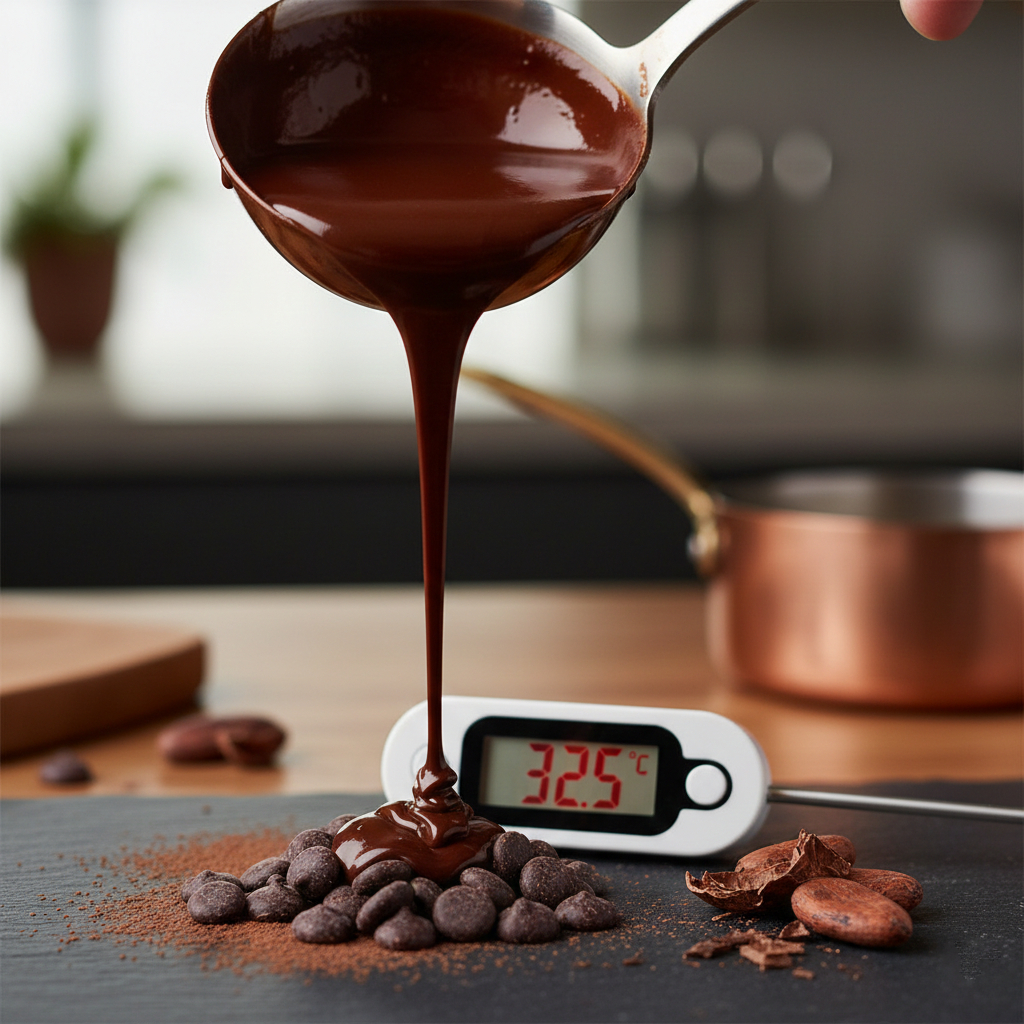
“Chocolate tempering is a fundamental scientific process used in the confectionery industry to stabilize cocoa butter crystals.”
In the industrial production of high-end confectionery, the difference between a luxury product and a defective batch lies in a single physical process: Chocolate Tempering. For a chocolate engineer or a serious artisan, chocolate tempering is not just a cooking step—it is a sophisticated exercise in molecular thermodynamics and material science.
Cocoa butter is a polymorphic fat, meaning it can crystallize into six different forms (Form I to Form VI). However, for industrial excellence, only Form V (Beta) provides the specific properties required for high-quality confectionery:
Without precise chocolate tempering, the cocoa butter crystallizes inconsistently, leading to a dull appearance and a crumbly texture that fails international quality standards.
To truly master chocolate tempering, one must observe the triacylglycerol network. Cocoa butter is primarily composed of POP, POS, and SOS triglycerides. During the cooling phase, if the temperature drops too slowly or incorrectly, the crystals form a loose, unstable lattice (Forms I through IV).
These unstable forms have a lower melting point, which is why poorly tempered chocolate feels “waxy” and melts instantly on the fingers. Form V, on the other hand, creates a dense, tightly packed crystalline structure that offers maximum resistance to fat migration to the surface.
Achieving the Form V crystal requires a strict thermal cycle. While variables change based on formulation, the standard protocol for chocolate tempering is illustrated in the data below:
Engineer’s Note: A deviation of just 1°C during the stabilization phase can compromise the molecular integrity of the entire batch, leading to production delays.
In an automated environment, several factors can ruin the chocolate tempering process:
How do engineers verify chocolate tempering in real-time?
For more in-depth research on food thermodynamics, the provides extensive data on lipid crystallization. Additionally, check our previous guide on to understand how bean quality affects the final temper.
The Role of Mechanical Shear in Crystallization In a professional setting, successful chocolate tempering involves more than just monitoring thermal values. Mechanical shear, or constant agitation, is essential for the uniform distribution of stable Form V seeds throughout the cocoa butter matrix. Without proper mixing during the cooling phase, the chocolate tempering process might fail to produce a consistent crystalline structure, leading to localized defects or fat bloom. Advanced industrial temperers utilize scraped-surface heat exchangers to provide the precise combination of cooling and movement required. Mastering this balance between thermodynamics and fluid mechanics is what ensures a high-quality finish in large-scale confectionery manufacturing.
Ultimately, professional chocolate tempering requires high-precision equipment and deep knowledge of lipid crystallization. By following these technical standards, manufacturers can ensure consistent quality in every chocolate batch produced.