All the world of cacao in one click.


Enhance your atelier with AI: Our expert tutorial reveals the 4 key steps to seamlessly incorporate AI into your creative workflow.
You are about to embark on a revolutionary baking journey, where the art of traditional baking meets the precision of AI-driven techniques. By incorporating predictive modeling into your baking process, you can enhance the quality and consistency of your baked goods.
To get started, you’ll need a few essential ingredients, which are listed in the table below using Baker’s percentage. This professional recipe is designed to help you create delicious treats with the aid of AI in baking.
In the world of baking, the ingredients you choose are the foundation upon which your creations are built. Understanding the role of each component and the importance of quality ingredients is crucial for achieving the desired outcome.
Each ingredient in your recipe serves a specific purpose. For instance, flour provides structure, water hydrates, yeast ferments, and salt enhances flavor. Understanding these roles allows you to make informed decisions when adjusting your recipe.
Predictive modeling can also play a significant role in optimizing your ingredient usage, helping to reduce raw material waste. By analyzing data on ingredient quantities and their impact on the final product, you can refine your recipes to be more efficient.
The quality of your ingredients directly affects the final product. Using high-quality ingredients ensures consistency and excellence in your baked goods. For example, high-protein flour can improve dough strength, while fresh yeast can enhance fermentation.
Here’s a breakdown of a basic bread recipe using Baker’s percentage, which helps in understanding the proportion of each ingredient relative to the total flour weight:
| Ingredient | Baker’s Percentage (%) |
|---|---|
| Flour | 100 |
| Water | 65 |
| Yeast | 2 |
| Salt | 2 |
By understanding the ingredient overview and using quality ingredients, you can significantly improve your baking results. This foundation is crucial for experimenting with new recipes and techniques.
Baker’s percentage is a simple yet powerful tool that allows bakers to adjust ingredient ratios with precision. This method of measuring ingredients is based on the total weight of flour in a recipe, making it a fundamental concept in baking.
Baker’s percentage is defined as the ratio of the weight of an ingredient to the total weight of flour, expressed as a percentage. For example, if a recipe calls for 1 kg of flour and 600 grams of water, the Baker’s percentage for water would be 60%. This system allows bakers to easily scale recipes up or down while maintaining the balance of ingredients.
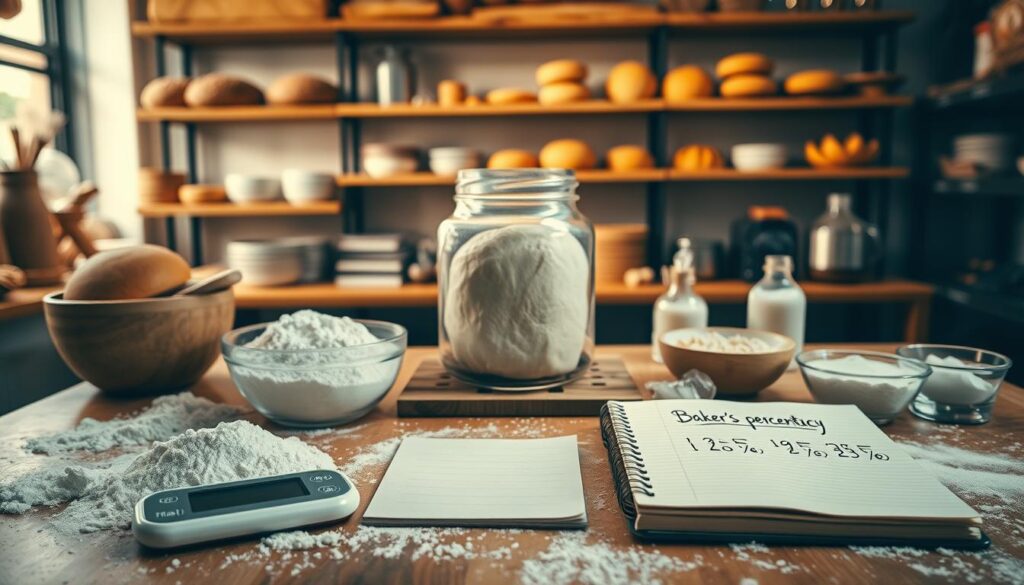
Calculating Baker’s percentage involves a straightforward process:
For instance, if you’re using 500 grams of flour and 350 grams of water, the Baker’s percentage for water is calculated as (350 / 500) * 100 = 70%. This means water is 70% of the flour’s weight.
By understanding and applying Baker’s percentage, you can leverage AI in recipe formulation to experiment with new ingredient ratios and create innovative recipes. Whether you’re adjusting a traditional recipe or developing a new one, Baker’s percentage provides a clear and efficient way to achieve the desired outcome.
Baking like a professional requires a well-equipped atelier, where traditional techniques meet modern AI integration. As you set up your baking space, it’s essential to understand the tools and technology that will help you achieve consistency and innovation in your creations.
Every baker needs a set of fundamental tools to start with. These include a digital scale for precise measurements, a mixing bowl set for preparing dough, and a baking sheet for perfectly baked goods. Investing in quality tools not only makes the baking process smoother but also ensures that your final products are of high quality.
Some of the must-have tools include:
The integration of AI in baking has revolutionized the way bakers work. From AI-powered mixing tools that adjust ingredients based on environmental conditions to smart ovens that monitor baking time and temperature, technology has made it easier to achieve consistent results.
Here’s a comparison of traditional baking tools with their AI-integrated counterparts:
| Tool | Traditional | AI-Integrated |
|---|---|---|
| Mixing | Manual or stand mixer | AI-powered mixer adjusting ingredients in real-time |
| Oven | Conventional oven | Smart oven monitoring temperature and baking time |
| Dough Preparation | Manual kneading or dough mixer | Automated dough preparation with AI-optimized kneading times |
By embracing AI integration, you can enhance your baking process, making it more efficient and innovative. Whether you’re a seasoned baker or just starting, understanding the role of technology in baking will help you stay ahead in the world of culinary arts.
To create exceptional pastries, it’s essential to comprehend the role of each ingredient. The ingredients used in your recipe are the building blocks of your final product, and understanding their functions is crucial for achieving the desired outcome.
Flour is the primary ingredient in most baked goods, providing structure and texture. The type of flour used can significantly impact the final product, with options ranging from all-purpose flour to bread flour, cake flour, and pastry flour. All-purpose flour is a versatile choice, suitable for a wide range of baked goods.
The protein content in flour is a critical factor, as it affects the dough’s strength and elasticity. For instance, bread flour typically has a higher protein content than all-purpose flour, making it ideal for breads that require a chewy texture.
Water is another essential ingredient, playing a crucial role in hydrating the flour and facilitating the dough’s development. The temperature and quality of the water can impact the final product, with cold water typically preferred to slow down yeast activity.
The ratio of water to flour is also critical, as it affects the dough’s consistency and texture. A higher hydration level can result in a more tender crumb, while a lower hydration level can produce a denser loaf.
Yeast is responsible for fermentation, the process by which the dough rises. There are different types of yeast, including active dry yeast, instant yeast, and sourdough starter. Active dry yeast is a popular choice for many bakers, as it is easy to use and provides consistent results.
The amount of yeast used can impact the fermentation rate, with more yeast resulting in a faster rise. However, using too much yeast can lead to an over-proofed dough, negatively affecting the final product’s texture and flavor.
Salt is a critical ingredient, enhancing the flavor of the baked goods and controlling yeast activity. The type and amount of salt used can vary depending on the recipe and personal preference.
Using the right amount of salt is crucial, as too little salt can result in a bland flavor, while too much salt can inhibit yeast activity and affect the dough’s rise.
| Ingredient | Function | Impact on Final Product |
|---|---|---|
| Flour | Provides structure and texture | Affects texture and crumb |
| Water | Hydrates flour and facilitates dough development | Influences dough consistency and texture |
| Yeast | Responsible for fermentation | Affects rise and flavor |
| Salt | Enhances flavor and controls yeast activity | Impacts flavor and rise |
The journey to creating the perfect dough begins with understanding the intricacies of dough preparation, from mixing techniques to the importance of resting the dough. As you embark on this process, it’s essential to recognize that the quality of your dough directly influences the final baked product.
Effective mixing is the foundation of creating a superior dough. To achieve this, follow these steps:
Tip: Avoid overmixing, as it can lead to a dense final product. The goal is to develop the gluten just enough to create a dough that is both tender and robust.
Resting the dough is a critical step that allows the gluten to relax, making the dough easier to work with and contributing to a better texture in the final product. As
“The resting period is where the magic happens, allowing the flavors to develop and the dough to become more pliable.”
To rest your dough effectively:
By following these mixing and resting techniques, you’ll be well on your way to creating the perfect dough for your baking needs.
Fermentation and proofing, though often used interchangeably, are distinct processes that together contribute to the final product’s quality. Fermentation is a biochemical process where yeast converts sugars into carbon dioxide, causing the dough to rise. Proofing, on the other hand, refers to the stage where the dough is allowed to rest and rise further before baking.
Temperature plays a crucial role in fermentation. Yeast activity is highly temperature-dependent; too high or too low temperatures can either over-activate or inhibit yeast, affecting the fermentation process. Ideally, fermentation should occur at a temperature between 75°F and 80°F (24°C to 27°C) for most bread types.
Maintaining the right temperature ensures that fermentation proceeds at a steady pace, contributing to the development of the dough’s flavor and texture. Temperature control is thus vital for achieving consistent results.
Determining when the dough is ready involves observing several signs. The dough should have doubled in size, and when gently pressed, it should spring back slowly. Over-proofed dough will not spring back and may collapse during baking.
By carefully monitoring these signs and controlling the fermentation temperature, you can ensure that your dough is perfectly proofed and ready for baking.
Shaping dough is an art that requires precision, patience, and practice to achieve consistent results. As a professional baker, mastering various shaping techniques is crucial for creating visually appealing and delicious bread.
To shape like a professional, you need to understand the fundamentals of dough manipulation. This involves developing the gluten in the dough to create a smooth, elastic texture that can be shaped into various forms.
Gently degas the dough to release any air bubbles that may have formed during the proofing process. Begin by folding the dough over itself several times to develop the gluten, then use a gentle stretching motion to shape it into the desired form.
To achieve professional results, it’s essential to maintain consistency in your shaping technique. Use a bench scraper to handle the dough gently and prevent it from sticking to the counter.
Consistency is key to producing high-quality bread. To achieve this, pay attention to the temperature and humidity of your proofing environment, as these factors can significantly impact the final product.
| Shaping Technique | Effect on Crust | Effect on Crumb |
|---|---|---|
| Circular Tension | Creates a crispy, evenly browned crust | Results in a tender, airy crumb |
| Stretching and Folding | Develops a more complex crust flavor | Produces a denser, chewier crumb |
| Tucking and Rolling | Creates a crust with a delicate texture | Results in a soft, evenly textured crumb |
“The art of bread making is not just about following a recipe, it’s about understanding the dough and working with it to create something truly special.” – Anonymous
By mastering shaping techniques and maintaining consistency, you can elevate your baking to a professional level. Remember, practice is key to developing the skills needed to produce high-quality bread consistently.
Achieving a perfectly baked loaf requires attention to detail during the baking process. This stage is crucial as it transforms your carefully prepared dough into a beautifully baked product.
Preheating your oven is a critical step that ensures your loaf bakes evenly. To preheat correctly, follow these steps:
Monitoring the bake time and temperature is vital to achieving a perfectly baked loaf. Here’s how to do it:
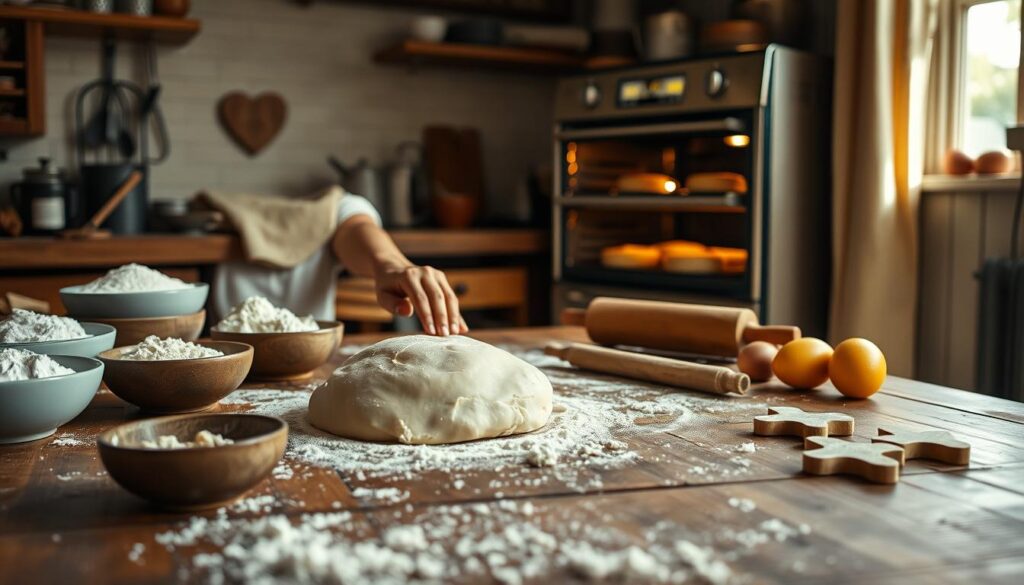
By following these guidelines, you can ensure that your baking process is executed correctly, resulting in a perfectly baked loaf every time. Attention to detail during this stage is what separates a good baker from a great one.
To create a truly exceptional bread, you need to master the art of dough flavoring. Flavoring your dough is a crucial step that can elevate your bread from ordinary to extraordinary. By incorporating the right ingredients, you can create a loaf that is not only delicious but also visually appealing.
Herbs and spices are a great way to add depth and complexity to your bread. Popular herbs like rosemary, thyme, and oregano can be added fresh or dried, depending on your preference. Spices like cinnamon, nutmeg, and cardamom can add a warm, aromatic flavor. When using herbs and spices, start with a small amount and taste as you go, adjusting the seasoning to your liking.
For example, a rosemary and olive oil bread can be made by mixing in chopped rosemary leaves and a drizzle of olive oil into the dough. Similarly, a cardamom-infused bread can be created by adding ground cardamom to the dough.
Fruits and nuts can add natural sweetness, texture, and flavor to your bread. Dried fruits like cranberries, raisins, and cherries are popular choices, while nuts like walnuts, almonds, and hazelnuts can add a satisfying crunch. When incorporating fruits and nuts, be mindful of the moisture content and adjust the liquid in the recipe accordingly.
A good example is a cranberry orange bread, made by adding dried cranberries and orange zest to the dough. Another example is a walnut bread, created by mixing in chopped walnuts.
By experimenting with different combinations of herbs, spices, fruits, and nuts, you can create a wide variety of unique and delicious breads.
The final steps in baking are just as crucial as the initial preparation, involving cooling, storing, and presentation. These steps are essential in maintaining the quality and enhancing the appeal of your baked goods.
Cooling your baked goods properly is vital to prevent moisture buildup, which can lead to sogginess or mold. You should cool your creations on a wire rack to allow air to circulate around them. Once cooled, storing them in airtight containers helps maintain freshness.
For longer-term storage, consider using techniques like freezing. Many types of baked goods can be frozen to preserve their freshness. When you’re ready to serve, simply thaw at room temperature or reheat as needed.
| Storage Method | Best For | Duration |
|---|---|---|
| Airtight Containers | Cookies, Cakes | 3-5 days |
| Freezing | Breads, Pastries | 2-3 months |
Presentation is a critical aspect of baking, and AI tools can significantly enhance the visual appeal of your creations. Using AI-powered design software, you can generate decorative ideas, predict color schemes, and even automate the decoration process.
Predictive modeling can also help reduce raw material waste by 15-20% by optimizing ingredient usage and minimizing overproduction. This not only saves resources but also contributes to more sustainable baking practices.

By leveraging these technologies, you can elevate your baking to the next level, combining traditional techniques with modern innovation.
As you’ve explored the world of AI in baking, you’ve seen how technology can enhance traditional techniques. From understanding the role of each ingredient to leveraging AI tools for presentation, the possibilities are vast.
The future of baking is exciting, with AI innovations poised to revolutionize the industry. Expect to see more sophisticated algorithms and machine learning models that can help you perfect your craft.
We encourage you to experiment with new techniques and ingredients in your atelier. Whether you’re a seasoned baker or just starting out, the key to success lies in embracing experimentation and staying open to new ideas.
By combining traditional baking methods with AI innovations, you can unlock new flavors, textures, and presentation styles that will take your baking to the next level.