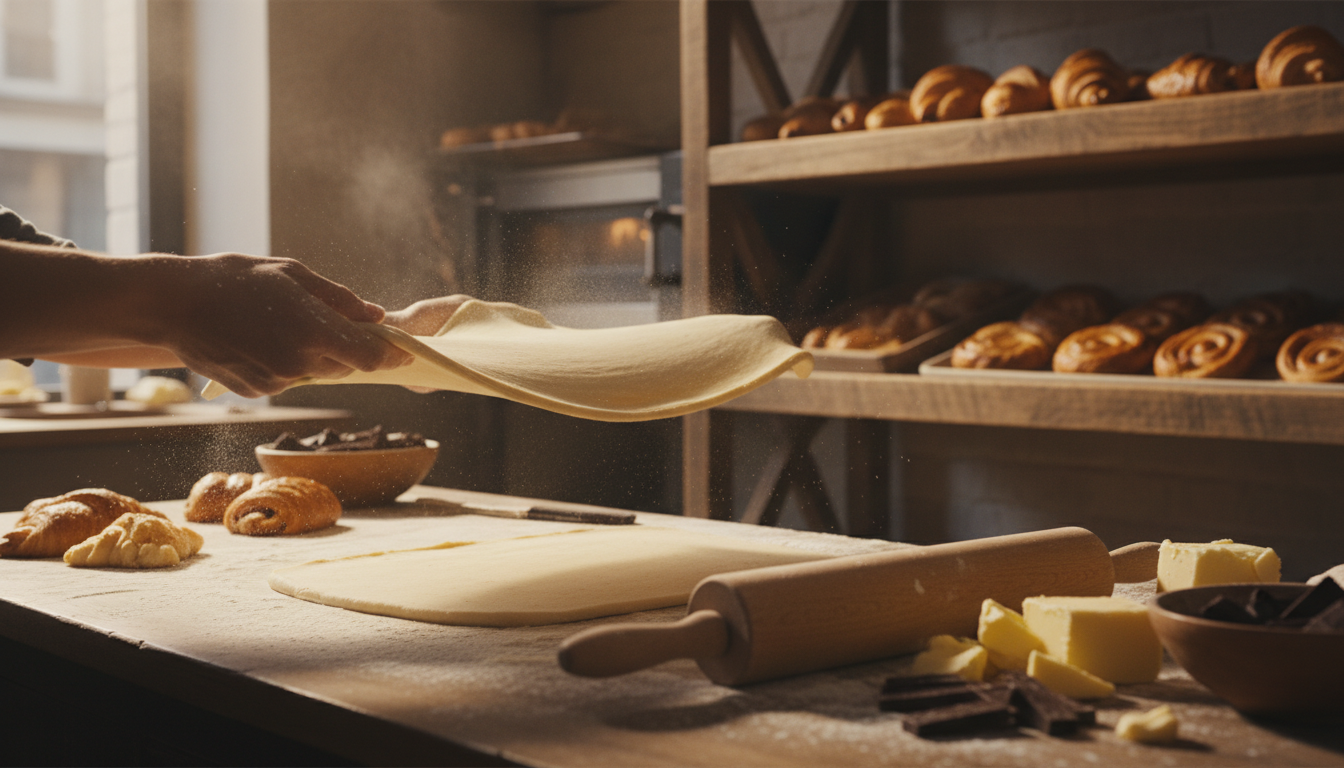
Mastering a classic French pastry requires you to understand the physics of gluten and fat. You must control your dough carefully to get the best results. A firm Dough Elasticity ensures that your layers stay distinct during the rolling process.
Managing the Lamination Heat is essential for achieving a perfect honeycomb internal structure. This professional recipe focuses on maintaining structural integrity through every fold. You will create a product that shatters beautifully with every single bite.
| Ingredient |
Baker’s Percentage (%) |
| Bread Flour |
100% |
| Water (Cold) |
45% |
| Whole Milk |
10% |
| Granulated Sugar |
12% |
| Unsalted Butter (Dough) |
10% |
| Sea Salt |
2% |
| Instant Yeast |
3% |
| Roll-in Butter (Dry) |
50% |
- Mix all dough ingredients until a smooth surface forms to build Dough Elasticity.
- Rest the dough in the refrigerator for at least two hours to relax the gluten.
- Encase the cold butter block within the dough and seal the edges tightly.
- Complete three single folds, chilling the dough between each turn for stability.
- Shape the pastries and proof them at room temperature until they double in size.
- Bake in a preheated oven until the exterior reaches a deep golden brown.
Key Takeaways
- Always keep your ingredients and work surface very cold.
- Measure all ingredients by weight for consistent professional results.
- Allow the dough to rest sufficiently to prevent shrinking during baking.
- Use high-fat European-style butter for better flakiness and flavor.
- Monitor oven temperatures closely to ensure an even rise.
- Check the internal crumb for a defined spiral pattern.
Controlling Butter Melting Points
Lamination success hinges on the ability to control butter melting, a feat that requires a deep understanding of butter’s composition and behavior. You need to grasp how butter acts under various conditions to achieve the perfect pain au chocolat.
Understanding Butter Composition
Butter is primarily composed of fat, water, and milk solids. The plasticity of butter, which refers to its ability to be shaped and molded without breaking, is crucial for successful lamination. As noted by experts, “The right balance between firmness and pliability is key to achieving the desired layers in pastry dough.”
“The plasticity of butter is a critical factor in lamination, as it directly affects the dough’s ability to be rolled and folded without cracking.”
Factors Affecting Butter Melting
Several factors can influence the melting behavior of butter, including:
- Temperature: Butter melts when exposed to high temperatures, so maintaining a cool environment is essential.
- Handling: Overworking or excessive handling can cause butter to soften and lose its plasticity.
- Quality: High-quality butter with the right fat content is more likely to retain its desired properties during lamination.
To manage these factors effectively, follow these steps:
- Keep your workspace cool to prevent butter from melting.
- Handle the dough gently to maintain the integrity of the butter layers.
- Choose high-quality butter with a high fat content for better plasticity.
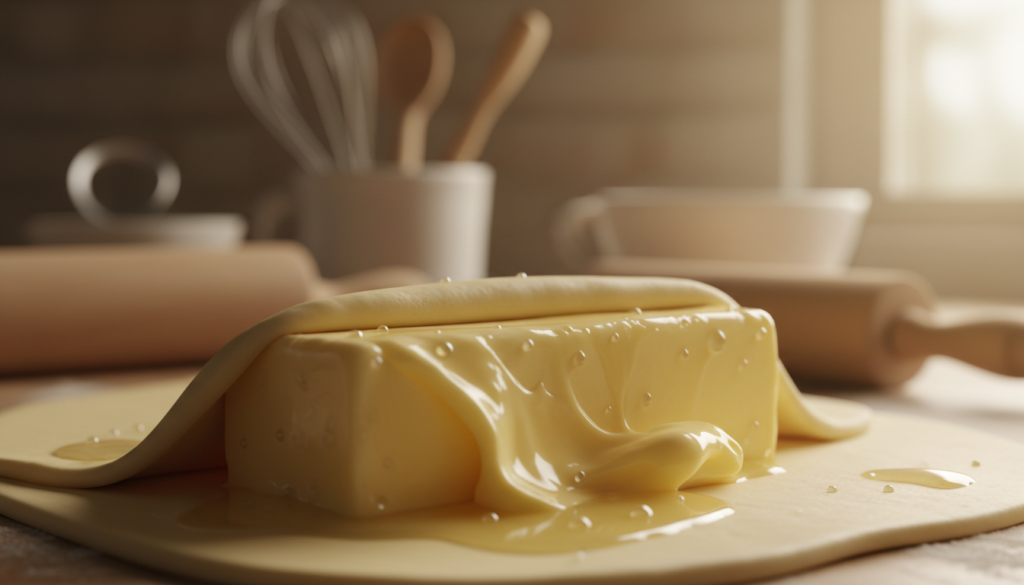
By understanding and controlling these factors, you can ensure that your butter remains pliable and your lamination is flawless, resulting in a pain au chocolat with the perfect layers.
16-Layer Lamination Science
The pursuit of the perfect pain au chocolat leads to the fascinating world of 16-layer lamination science, where thermal expansion plays a crucial role.
To create the flaky, tender texture characteristic of pain au chocolat, you must master the art of lamination. This involves not just the rolling and folding of dough, but a thorough comprehension of how the layers interact during the baking process.
The Importance of Layering
Layering is crucial because it allows for the even distribution of butter and dough, ensuring that each bite of the pain au chocolat has the perfect balance of flavors and textures.
Techniques for Achieving Uniform Layers
To achieve uniform layers, follow these steps:
- Ensure your butter block and dough are at the same temperature before laminating.
- Roll out the dough evenly, maintaining consistent thickness.
- Fold the dough precisely, ensuring that the edges are aligned and the layers are not distorted.
- Repeat the rolling and folding process the required number of times to achieve 16 layers.
Understanding thermal expansion is key to successful lamination. As the dough bakes, the layers expand at different rates due to their composition, contributing to the flaky texture.
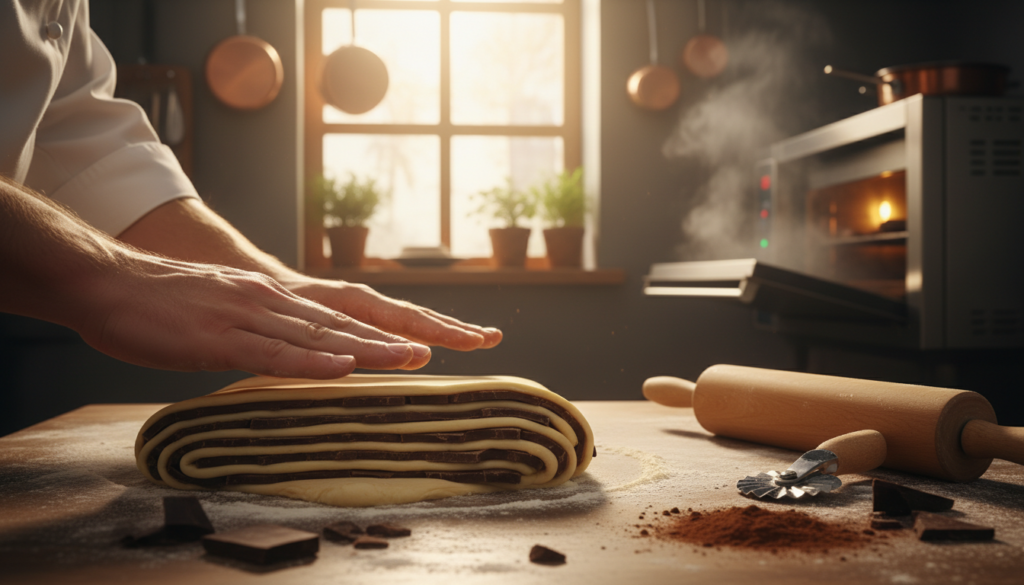
Managing lamination heat is also vital. The temperature at which you laminate and bake your dough affects the melting point of the butter and, consequently, the layer integrity.
| Step |
Temperature Control |
Action |
| 1 |
Keep butter and dough at the same temperature. |
Laminate dough |
| 2 |
Maintain consistent refrigeration temperature. |
Rest the dough |
| 3 |
Monitor oven temperature precisely. |
Bake the pain au chocolat |
Achieving the “Shatter” Crust
To create the perfect pain au chocolat, achieving the “shatter” crust is crucial. This is where the magic happens, and your pastry transforms into a masterpiece. The key to this lies in understanding the role of dough elasticity and leveraging lamination heat.
Elasticity and Lamination
Dough elasticity plays a significant role in determining the crust’s texture. When you balance dough elasticity with the right lamination heat, you achieve a crust that is both flaky and crispy.
Baking Techniques for the Perfect Crust
To achieve the perfect “shatter” crust, follow these steps:
1. Preheat your oven to the optimal baking temperature of 400°F (200°C).
2. Place your pain au chocolat on a baking sheet lined with parchment paper, ensuring they are evenly spaced.
3. Bake for 15-20 minutes or until the crust is golden brown, leveraging lamination heat to enhance the texture.
4. Monitor the baking time to achieve the perfect balance between flakiness and crispiness, influenced by dough elasticity.
By mastering these techniques and understanding the importance of dough elasticity and lamination heat, you will be able to create pain au chocolat with a signature “shatter” crust that will impress any pastry enthusiast.
FAQ
How does Dough Elasticity impact the final structure of your pain au chocolat?
Dough Elasticity is fundamental to the lamination process because it allows the dough to stretch without tearing as you incorporate the butter block. If the dough lacks sufficient elasticity, the layers will break, leading to an uneven rise. By developing the gluten properly through precise mixing and resting, you ensure the dough can withstand the pressure of the rolling pin while maintaining the integrity of the 16-layer structure.
What is the significance of Butter Plasticity when laminating?
Butter Plasticity refers to the state where butter is pliable enough to be rolled thin without snapping or melting into the dough. To achieve a professional result, you must ensure the butter and the dough are at the same temperature and consistency. Utilizing high-fat European-style butters, such as Plugra or Isigny Sainte-Mère, provides the necessary plasticity to create continuous, microscopic layers that are essential for a successful bake.
How does Thermal Expansion create the signature “shatter” crust?
The “shatter” crust is a result of rapid Thermal Expansion that occurs the moment your pastry hits the high heat of the oven. As the moisture within the dough and butter layers turns to steam, it forces the layers upward and apart. This expansion, combined with the caramelization of the outer surface, creates a delicate, paper-thin crust that shatters upon impact, a hallmark of a masterfully crafted pain au chocolat.
Why is managing Lamination Heat critical during the folding process?
If your workspace or dough exceeds the optimal temperature, you risk the butter melting into the flour, which transforms your flaky pastry into a dense, brioche-like bread. Managing Lamination Heat involves chilling your dough and equipment frequently to keep the fat solid. This ensures that the distinct layers remain separate until they reach the oven, where they can properly expand.
Why is the Baker’s percentage used for professional pastry recipes?
Using the Baker’s percentage allows you to maintain total control over the hydration and fat content of your recipe, regardless of the batch size. By calculating every ingredient as a percentage of the total flour weight, you can ensure consistency in your Dough Elasticity and overall crumb structure, which is vital for high-end production in professional environments like Tartine Bakery or Dominique Ansel Bakery.
How do you achieve uniform layers in a 16-layer lamination?
Uniformity is achieved through precise measurements and maintaining Butter Plasticity. You must trim the edges of your dough during the folding process to expose the “book” of layers and ensure that the butter is distributed evenly from edge to edge. This precision prevents lopsided growth during Thermal Expansion and results in a perfectly symmetrical honeycomb interior when the pastry is sliced.