All the world of cacao in one click.


Prevent stale popcorn with this tutorial on creating a popcorn barrier to maintain freshness in high humidity. Learn the Popcorn Barrier technique.
Humidity is the primary enemy of high-quality gourmet snacking experiences. When you integrate crunchy inclusions, maintaining a crisp texture requires a technical approach to prevent moisture migration. You must understand how to protect your ingredients to ensure a long shelf life in any climate.
This professional recipe uses a specific fat-based barrier to keep the light, airy kernels from turning chewy. By mastering these ratios, you can produce consistent results even in damp environments. These decadent treats offer a perfect balance of salt and sweet for your customers.
Start by gathering your high-quality components and measuring them with precision. Using a professional formula ensures that every batch maintains the same flavor profile and structural integrity. Below is the ingredient breakdown using the Baker’s percentage method for your production scale.
| Ingredient | Baker’s Percentage (%) |
|---|---|
| Dark Couverture Chocolate | 100% |
| Heavy Cream (36% Fat) | 45% |
| Unsalted Butter | 12% |
| Air-Popped Popcorn | 15% |
| Flaked Sea Salt | 2% |
Follow these numbered steps to create the perfect popcorn truffle. Ensure your workspace is temperature-controlled for the best chocolate tempering results. Precision at each stage will guarantee a professional finish and a satisfying crunch.
To keep your salted popcorn truffles fresh, it’s crucial to understand and combat moisture migration. Moisture migration refers to the movement of moisture from one component to another within your truffles, which can cause the popcorn to become stale.
Moisture migration is a significant challenge when making salted popcorn truffles. It occurs when there’s a difference in moisture content between the popcorn and other ingredients, such as toffee or chocolate coatings.
Factors influencing moisture migration include:
One effective way to prevent moisture migration is by applying a barrier coating to the popcorn. Cocoa butter is an excellent coating for this purpose. It acts as a hydrophobic layer, preventing moisture from penetrating the popcorn.
The process involves melting the cocoa butter to the right temperature and then evenly coating the popcorn. This step is crucial for maintaining the crunchiness of the popcorn.
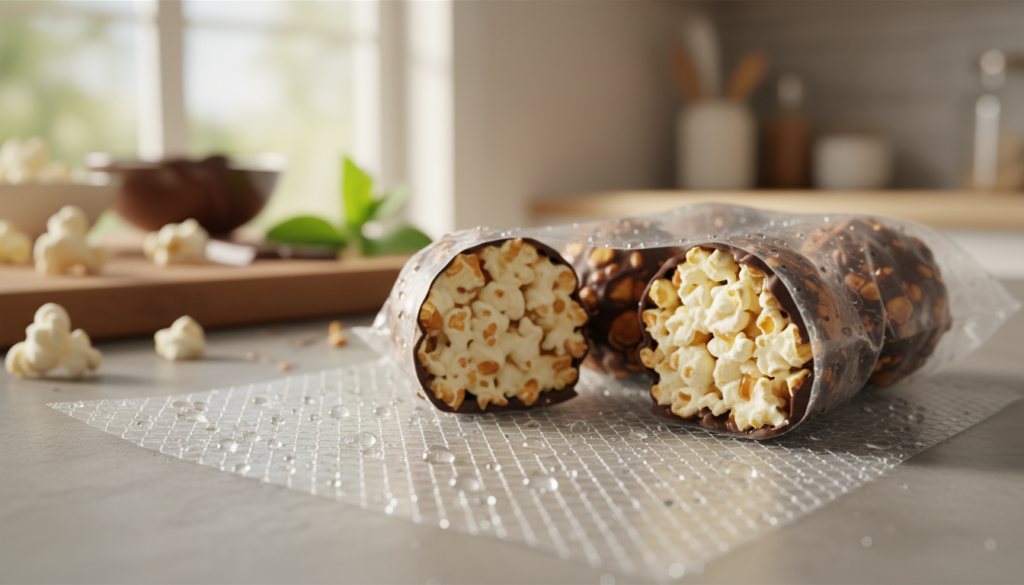
A comparative analysis of different coatings can help you choose the best option for your salted popcorn truffles.
| Coating Type | Moisture Barrier Effectiveness | Flavor Impact |
|---|---|---|
| Cocoa Butter | High | Rich, Chocolatey |
| Wax Coating | Medium | Neutral |
| Toffee Barrier | Low | Sweet, Caramel-like |
Achieving the perfect salt-sugar balance in your snacking inclusions involves understanding the underlying physics. The human tongue perceives different tastes through complex mechanisms that involve the interaction of molecules with taste receptors.
The balance between salt and sugar is not just about the ratio of these two ingredients; it’s also about how other components in your recipe interact with them. For instance, the type of sugar used can affect the perception of saltiness, and vice versa.
Understanding Taste Perception
Taste perception is a multifaceted process that involves not just the taste buds on the tongue but also the sense of smell and the texture of the food. When it comes to salted popcorn truffles, the combination of salty and sweet flavors creates a unique taste experience.

To fine-tune your recipe, consider the following factors that influence the salt-sugar balance:
A well-balanced salt-sugar ratio can be achieved by experimenting with different combinations and testing the outcome. Here’s a simple table to guide your experimentation:
| Salt Type | Sugar Type | Perceived Taste |
|---|---|---|
| Fine Salt | Granulated Sugar | Balanced |
| Coarse Salt | Brown Sugar | Slightly Sweet |
| Sea Salt | Powdered Sugar | Savory |
By understanding the physics behind the salt-sugar balance and experimenting with different ingredients and ratios, you can create salted popcorn truffles that are perfectly balanced for snacking.
Proper packaging is the final defense against moisture migration, ensuring your salted popcorn truffles remain crunchy. By now, you’ve created a toffee barrier and achieved the right salt-sugar balance. The next step is to select packaging that prevents moisture from entering and maintains the internal environment.
To maintain crunchiness, you need airtight packaging that acts as a barrier against external moisture. Materials with a low moisture vapor transmission rate are ideal. This ensures that the internal environment remains dry, preserving the texture of your truffles.
When choosing packaging, consider the storage conditions and distribution channels. Your packaging should be designed to protect the truffles from moisture migration, keeping them fresh until consumed.