All the world of cacao in one click.


Learn the secrets to making thermostable chocolate that can withstand temperatures up to 40°C. A tutorial on natural heat-resistant chocolate.
Dealing with high temperatures is a constant challenge for professional confectioners. You can now master the art of producing high-quality bars that stay firm in the sun. This professional guide focuses on achieving a 40°C melting point using specific natural ingredients.
Understanding the science behind heat resistance ensures your products maintain their premium look. By adjusting the fat matrix, you create a Thermostable Choc that resists blooming and softening. This method is essential for shipping products to warmer regions within the United States.
| Ingredient | Baker’s Percentage (%) |
|---|---|
| Cocoa Mass | 100.0% |
| Sugar (Fine) | 92.0% |
| Cocoa Butter | 18.0% |
| Natural Stabilizing Agent | 3.5% |
| Soy Lecithin | 0.4% |
Understanding the physics behind chocolate’s melting behavior is essential for creating thermostable chocolate. The melting point of chocolate is not just a simple physical property; it’s a complex characteristic influenced by its composition.
The lipid profile of chocolate plays a significant role in determining its melting behavior. Chocolate contains a mixture of different fats, each with its own melting point. By adjusting the types and proportions of these fats, you can significantly enhance the heat resistance of your chocolate products.
Melting behavior is closely related to the particle packing within the chocolate. The way particles are arranged affects how the chocolate melts. A well-packed structure can lead to a more stable chocolate product that resists melting at higher temperatures.

To achieve the desired melting behavior, it’s crucial to understand how different lipid profiles and particle packing arrangements impact the overall stability of the chocolate. This involves considering the types of fats used and how they interact with each other.
By carefully adjusting the lipid profile and optimizing particle packing, you can create chocolate products that remain stable even at elevated temperatures, making them ideal for distribution in warm climates or for outdoor events.
To create chocolate that remains stable at higher temperatures, you need to adjust the fat ratios naturally. This involves understanding the composition of the fats present in the chocolate and how they contribute to its overall stability.
The stability of chocolate is significantly influenced by its fat content. Fats, particularly cocoa butter, play a crucial role in determining the melting behavior of chocolate. Proper particle packing is essential for achieving the desired texture and stability.
Fat acts as a lubricant between the sugar and cocoa particles in chocolate, affecting its flow properties and mouthfeel. The type and amount of fat used can significantly impact the chocolate’s melting point.

Adjusting the fatty acid profiles of the cocoa butter can help in achieving a more stable chocolate product. This involves modifying the triglyceride composition to enhance the chocolate’s heat resistance. By optimizing the fatty acid profile, you can improve the overall quality and stability of your chocolate.
Effective particle packing ensures that the chocolate has a smooth texture and is less prone to melting. This is achieved by optimizing the size distribution of the particles, including sugar, cocoa, and milk powder, to minimize the voids between them.
Formulating chocolate that remains stable at temperatures up to 40°C is a nuanced process. This involves understanding the physical properties of chocolate and how they can be manipulated to achieve the desired thermostability.
To start, you need to adjust the fat ratios in your chocolate formulation. This is crucial because the type and proportion of fats directly influence the melting behavior of chocolate. Using a combination of fats with different melting points can help achieve a more stable product.
Once you have a formulation, the next step is to test its thermostability. This involves subjecting the chocolate to various temperatures and observing its behavior. You can use a controlled temperature environment or simply leave the chocolate in a warm place to see how it holds up.
Here are some key factors to consider when testing and refining your chocolate:
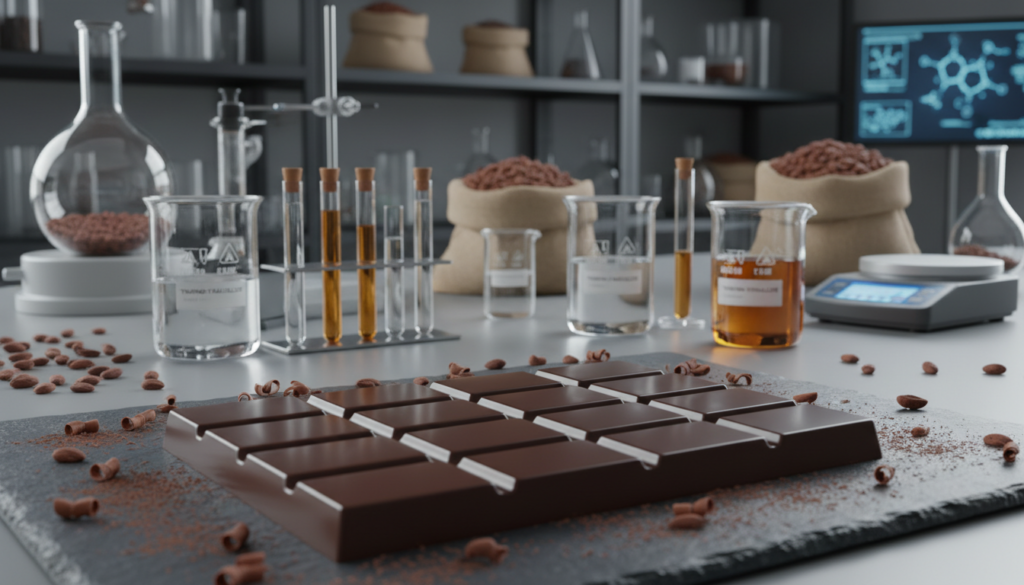
When refining your chocolate, it’s essential to make small adjustments and test frequently. This iterative process will help you achieve the perfect balance of taste and thermostability. Consider the following table as a starting point for your adjustments:
| Component | Initial Ratio | Adjustment |
|---|---|---|
| Cocoa Butter | 30% | +/- 5% |
| Sugar | 40% | +/- 2% |
| Milk Fat | 10% | +/- 3% |
By carefully adjusting these components and testing the resulting chocolate, you can develop a product that meets your thermostability requirements.
You’ve formulated your thermostable chocolate using the step-by-step guide provided earlier. Now, it’s time to put it to the test. To ensure your chocolate products remain stable during summer logistics, you need to simulate the high temperatures they will be exposed to.
Place your thermostable chocolate in a controlled environment with a temperature above 35°C. Observe its condition over time, checking for any signs of melting or deformation. This test will help you evaluate the heat resistance of your chocolate.
By successfully testing your thermostable chocolate, you can be confident that it will withstand the challenges of summer logistics, ensuring that your products reach consumers in perfect condition.